
Commercial Summaries
MRSA Nasal & Topical Decolonisation
For hospitals managing MRSA-carrier patients before admission, surgery, or transfer, aged care, and community health programmes. MRSA is one of the most costly and persistent hospital pathogens globally. Effective decolonisation directly reduces infection rates, length of stay, and antibiotic use.
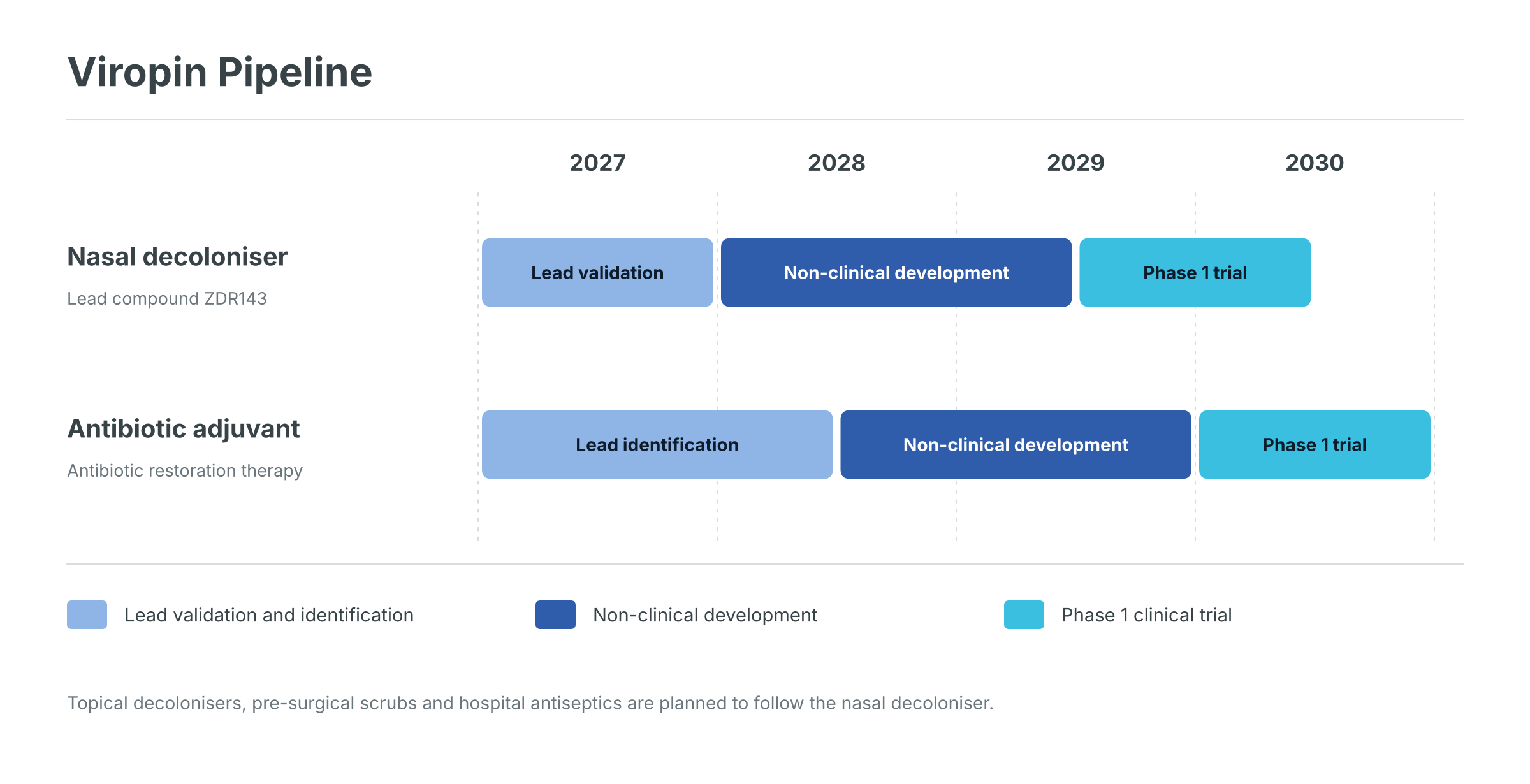
Led by a nasal decoloniser built on lead compound ZDR143. Lead validation in 2027, non-clinical development from 2028 to mid-2029, and a Phase 1 clinical trial from mid-2029 to mid-2030, with potential fast-track regulatory status in key markets, given the public health priority. International commercial partnerships under development.
Pre-Surgical Scrubs
Designed for surgical units, intensive care, and aged-care facilities. Hospital procurement teams already budget for this category. Viropin's products are being formulated to work against resistant organisms while fitting into existing infection-control protocols. Standard antiseptic and infection-control regulatory pathways across major markets.
Planned to follow the nasal decoloniser, building on the same platform and hospital relationships.
Hospital Decolonisers & Antiseptics
Targeted at hospital networks, infection-control teams, and aged-care providers. Used for environmental sanitation and patient decolonisation across the patient journey. Supporting protocols that reduce the spread of resistant bacteria and lower downstream antibiotic use.
Same regulatory pathway and timeline as the pre-surgical scrubs line, allowing parallel development and a shared commercial launch.
Antibiotic Restoration Therapy
Addressing the $157B antimicrobial resistance market growing at 15.3% CAGR. Designed for global hospital and clinical use against the highest-priority resistant pathogens on WHO and CDC watchlists. Restoring existing antibiotics is faster, cheaper, and clinically more deployable than developing new ones. Medicinal chemistry and lead identification run from 2027 to mid-2028, followed by non-clinical development to the end of 2029 and a Phase 1 clinical trial in 2030.
Later-stage trials and strategic exit options follow Phase 1.